What does door frame and hinge repair in Winnipeg cover?
Door frame and hinge repair covers the structural parts around and attached to a door that let it open, close, and latch without binding, sagging, or letting in drafts. This includes the jambs on either side, the head jamb across the top, the sill or threshold at the bottom, the hinges carrying the weight of the door leaf, and the fasteners, shims, and strike plates that keep everything aligned. In many Winnipeg homes and businesses, a door that sticks or won't latch isn't a problem with the door slab at all — it's the frame underneath that has shifted, cracked, rotted, or worked loose over years of use.
A DoorMend assessment for frame and hinge issues looks at the whole opening rather than treating symptoms in isolation. A loose hinge screw might be a quick fix, or it might be the first visible sign that the jamb has split, the building has settled, or moisture has gotten into the wood over several seasons. This service applies to exterior entry doors, interior doors, patio doors, and commercial entrances where the frame or hinge hardware is the source of the problem, covering both wood-frame and metal-frame openings.
- Realigning hinges and frames so doors swing freely without catching
- Repairing or replacing split, rotted, or cracked jamb material
- Re-setting strike plates and latch hardware to match a shifted frame
- Reinforcing hinge mortises that have become stripped or oversized
- Addressing sagging caused by worn or undersized hinges
Common signs your door frame or hinges need attention
Most Winnipeg homeowners notice a frame or hinge problem gradually. A door that used to close with a light push now needs a shoulder bump to latch. A door that sat flush in its frame last spring now shows a gap at the top corner. These slow changes often signal that the hinge or frame is moving rather than the door itself warping.
Visible sagging is one of the clearest signs: if the door dips at the outer top corner, or a triangle of light appears at the top of the frame when closed, the hinges are likely overloaded or the screws have worked loose. Squeaking or grinding when the door swings, especially after a change of season, often points to hinge wear or a frame that's no longer square.
- A gap or triangle of light at the top corner of a closed door
- A latch or deadbolt that needs the door lifted, pulled, or pushed to catch
- Visible sagging at the outer edge of the door, away from the hinge side
- Squeaking, grinding, or resistance when opening and closing
- Screws that spin without tightening into the jamb
- A door that swings open or shut on its own when unlatched
What causes door frames and hinges to fail?
Door frame problems in Winnipeg rarely have one single cause. More often it's a combination of age, moisture, use, and the building settling over time. Wood-frame doors are especially prone to swelling and shrinking as humidity changes between seasons, which loosens screws and widens the holes they sit in. Hinges also wear out mechanically: every swing of a heavy exterior door stresses the pins and screws anchoring the leaves into the jamb, and over thousands of openings the wood around screws compresses, especially where short screws only bit into the jamb rather than the framing behind it.
Water intrusion is another major factor, particularly at exterior doors without adequate weatherstripping or a properly sloped sill. Water sitting against the jamb can slowly rot it from the inside, often unnoticed until a hinge screw suddenly has nothing solid left to grip. Building settlement, more common in older Winnipeg homes on reactive clay soils, can also throw a frame slightly out of square, straining hinges installed when everything was still plumb.
How does Winnipeg's climate affect door frames and hinges?
Winnipeg's climate is hard on door hardware and framing. Winters dipping toward -30 °C cause materials to contract, while humid summers make wood swell. A door that fits perfectly in July can bind in January, and the reverse can happen too. Hinges and frames absorb this seasonal movement constantly, which is why repairs that look cosmetic in one season often reveal themselves more clearly in another.
Frost heave is a particular concern given Winnipeg's clay-heavy soils. As the ground freezes and thaws unevenly around a foundation, small shifts can transfer into the door frame, especially for openings near grade level such as garden doors and side entries. These shifts accumulate gradually, which is why a frame that was square when installed can be noticeably out of alignment years later.
Dry winter indoor air is also a factor. Forced-air heating pulls moisture out of indoor air, which can shrink wood jambs slightly and loosen screws that were snug in a more humid season. Road salt tracked in on footwear can work into the base of a frame near an entry threshold, contributing to corrosion on metal hardware and accelerating wood deterioration at the bottom of jambs over several winters.
What happens during a frame and hinge assessment?
An assessment starts with how the door behaves in its current frame: where it binds, where gaps appear, and whether the latch catches cleanly. A technician checks whether the frame is still plumb and square, since an out-of-true frame will keep pulling hinges loose no matter how many times they're tightened.
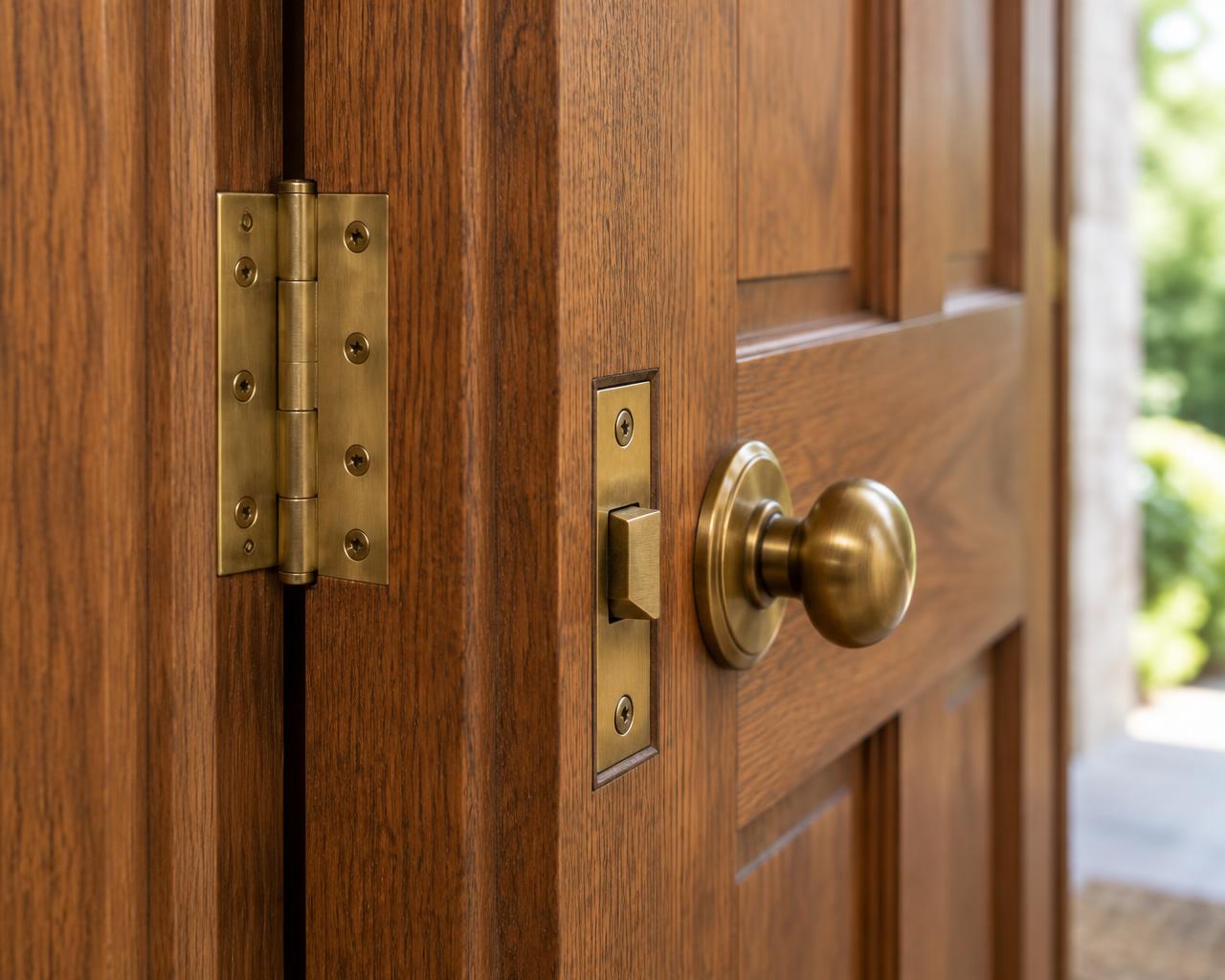
Next comes a close look at the hinges — checking for worn pins, bent leaves, stripped screw holes, and whether the hinge mortises are still solid or have become enlarged from years of adjustment. The condition of the wood or metal around each hinge matters as much as the hardware itself, since a new hinge set into soft, rotted wood will fail again quickly.
The assessment also examines the frame's structural condition along its full length: jambs for rot or splitting, the sill for water damage, and the strike plate area for wear or misalignment, noting whether shimming the existing frame is realistic or whether sections should be replaced.
- Checking the door's swing, latch, and gap consistency around the full frame
- Testing the frame for plumb and square
- Inspecting hinge pins, leaves, and screws for wear or damage
- Examining hinge mortises and surrounding wood or metal condition
- Checking jambs, sill, and threshold for rot, cracking, or water damage
What does the repair process typically involve?
A straightforward loose-hinge repair might involve removing the hinge, filling stripped screw holes with filler or glued dowels so screws have solid material to bite into, then reinstalling with longer screws that reach into the structural framing behind the jamb. This is a common fix for sagging doors and is often enough to correct a mild top-corner gap.
Where the frame has shifted out of square, the repair may involve carefully shimming behind the jamb at specific points to bring it back to plumb, then re-securing it so the alignment holds. For mechanically worn hinges, replacement hinges matched to the weight and size of the door are installed, sometimes upgraded to a heavier gauge if the original hardware was undersized.
More involved repairs come up when sections of jamb, sill, or head jamb have rotted or cracked. The damaged material is cut out, replaced with matching material, and re-anchored into the surrounding wall framing, with the strike plate adjusted so the latch and deadbolt catch cleanly.
Repair or replace, and what about wood, steel, fibreglass, or vinyl frames?
Wood frames, most common in older Winnipeg homes, offer the most flexibility for repair since damaged sections can be spliced with new wood. They're also the most vulnerable to moisture damage and seasonal swelling. Steel frames, common on commercial entrances, resist physical wear well but can rust at welds or where the frame meets a concrete sill, especially with road salt exposure. Fibreglass frames, a composite rather than glass, often have a wood or composite sub-frame behind the cladding, so hinges attach similarly to wood. Vinyl frames, common on patio doors, don't rot but can become brittle in extreme cold, and fasteners into vinyl can loosen with temperature cycling.
Whether a frame or hinge problem calls for repair or full replacement comes down to how much of the structure is still sound. If the jamb and rest of the frame are structurally solid and the issue is isolated to worn hinges, stripped screws, or a small section of damaged wood, repair is usually the more practical route.
Replacement becomes more sensible when rot or damage has spread through multiple sections of the frame, when the frame has been patched repeatedly and keeps failing in the same spots, or when other issues — poor insulation, outdated hardware, worn weatherstripping — are likely to surface again soon after a repair. There's also a middle ground: sometimes only the frame needs replacing while the existing door slab is reused, or vice versa, depending on which component is actually damaged. This is exactly the kind of decision that benefits from an in-person or photo-based assessment.
- Repair is usually appropriate for isolated hinge wear or minor localized frame damage
- Replacement is often more practical for widespread rot or repeated failures in the same spot
- A frame patched several times before may be near the end of its useful life
- Sometimes only the frame or only the door needs replacing, not both
What affects repair cost, and what can I check myself vs call a professional?
Cost varies based on several factors rather than a flat rate, since every opening presents a different combination of damage and access. The extent of damage is the biggest driver: tightening a couple of loose hinges is a much smaller job than replacing a rotted section of jamb running the full height of an opening.
The frame material also plays a role, since wood repairs involving splicing and matching trim profiles can take more time than straightforward hardware replacement on steel or vinyl. The number of hinges or openings involved matters too, and access or location within the building can add time, particularly for frames where trim and casing need careful removal and reinstallation. Because of all these variables, DoorMend provides cost information after an assessment rather than a price over the phone.
Some frame and hinge issues are safe for a homeowner to look at first. You can check whether hinge screws are loose with a screwdriver, and look for an obvious gap, sag, or daylight around the frame when the door is closed. Cleaning debris from hinge mortises and checking weatherstripping are also reasonable to inspect yourself.
It's fine to tighten an obviously loose screw if it still bites into solid wood. If the screw spins freely, the wood behind it is likely stripped or damaged, and repeatedly forcing a screw in isn't a lasting fix. If the frame looks cracked, split, or feels soft to the touch, it's better to stop there, since the surrounding wall framing may also need attention. Anything involving cutting into the frame, replacing structural jamb sections, re-squaring an out-of-plumb frame, or working on heavy commercial door hardware should be left to a trained technician.
- Extent of hinge wear or frame damage
- Frame material (wood, steel, fibreglass, or vinyl)
- Number of hinges, doors, or openings needing repair
- Accessibility of the frame and surrounding trim
- Whether hidden damage is found once work begins
- Safe to check: visible gaps, loose-looking screws, debris in hinge mortises, worn weatherstripping
- Safe to try: tightening a screw that still grips solid wood
- Stop and call a professional: screws that spin without tightening, cracked or soft frame wood
- Stop and call a professional: a frame that's visibly out of plumb or square
- Stop and call a professional: structural jamb replacement or heavy commercial hardware
Preventing frame and hinge problems from coming back
Once a repair is done, a few habits help it last through Winnipeg's seasonal swings. Periodically checking that hinge screws are snug, particularly after dry winter months, catches loosening before it turns into sagging. A light application of appropriate lubricant on hinge pins can also reduce wear from repeated use.
Keeping the base of exterior frames clear of snow, ice, and standing water helps prevent moisture from working into the wood over time, and wiping away road salt residue near entry thresholds reduces corrosion risk for metal hardware. Checking weatherstripping each fall helps keep moisture and drafts away from the frame itself, not just the door gap.
For businesses and condo buildings with heavier daily door traffic, periodically checking hinges on the most-used entrances can catch wear before it causes a service disruption, since a sagging commercial door can affect clearances and daily operations more noticeably than a single residential door.
Residential frame and hinge repair typically focuses on a single door experiencing a problem — an exterior entry sagging, a patio door frame shifted by settlement, or an interior door that's started to bind. For businesses and condo or apartment buildings, there are extra considerations: high-traffic commercial entrances see far more opening and closing cycles per day, which accelerates hinge wear and means frame problems can appear sooner than homeowners might expect.
- Check hinge screw tightness seasonally, especially after dry winter months
- Lubricate hinge pins periodically to reduce mechanical wear
- Clear snow, ice, and standing water from the base of exterior frames
- Inspect and refresh weatherstripping each fall
- For high-traffic business or condo entries, check hinges more frequently
Frequently asked questions about door frame and hinge repair
Can a sagging door always be fixed without replacing the frame? Not always, but it's common. Many sagging doors are caused by worn hinges or loosened screws rather than a failed frame, and reinforcing the hinge area often resolves the sag.
Why does my door only stick in certain seasons? Seasonal sticking is usually related to humidity and temperature changes affecting wood, rather than a permanent mechanical fault.
Is it normal for hinge screws to loosen over time? Yes, especially in wood frames. It's a bigger concern when the same screws keep loosening despite tightening, since that usually means the screw holes have worn out.
Can I replace a hinge myself? Many homeowners can replace a simple interior door hinge, but exterior doors, heavier doors, and frame damage are best left to a professional.
Does frame repair include fixing the door itself? Frame and hinge repair focuses on the frame and hardware; a damaged door slab is a related but separate issue DoorMend can also assess.
Will fixing the frame also fix drafts? Often, since proper alignment improves how weatherstripping seals. Worn weatherstripping may still need replacing separately.
How to request a door frame or hinge repair quote from DoorMend
If you're dealing with a sagging door, a frame pulled out of square, hinges that won't stay tight, or any combination of these in your Winnipeg home or business, the first step is to describe what you're noticing. Details like when the problem started, whether it changes with the seasons, and which part of the door it affects all help form a clearer picture before anyone sees the door in person.
Sending photos of the affected door and frame, including close-ups of any visible gaps and hinge hardware, allows for a more informed initial look at what might be going on, whether that's hinge wear, a shifted frame, or a sign of water damage needing closer inspection.
From there, an assessment determines the actual options available, whether that's a straightforward hinge and screw repair, a more involved frame section replacement, or a recommendation to consider full replacement if damage is extensive. Submitting an enquiry is not the same as booking a service appointment; it's simply the starting point for figuring out what your door and frame situation needs, whether it's for a single residential entry door or multiple openings across a commercial property in Winnipeg, Manitoba.