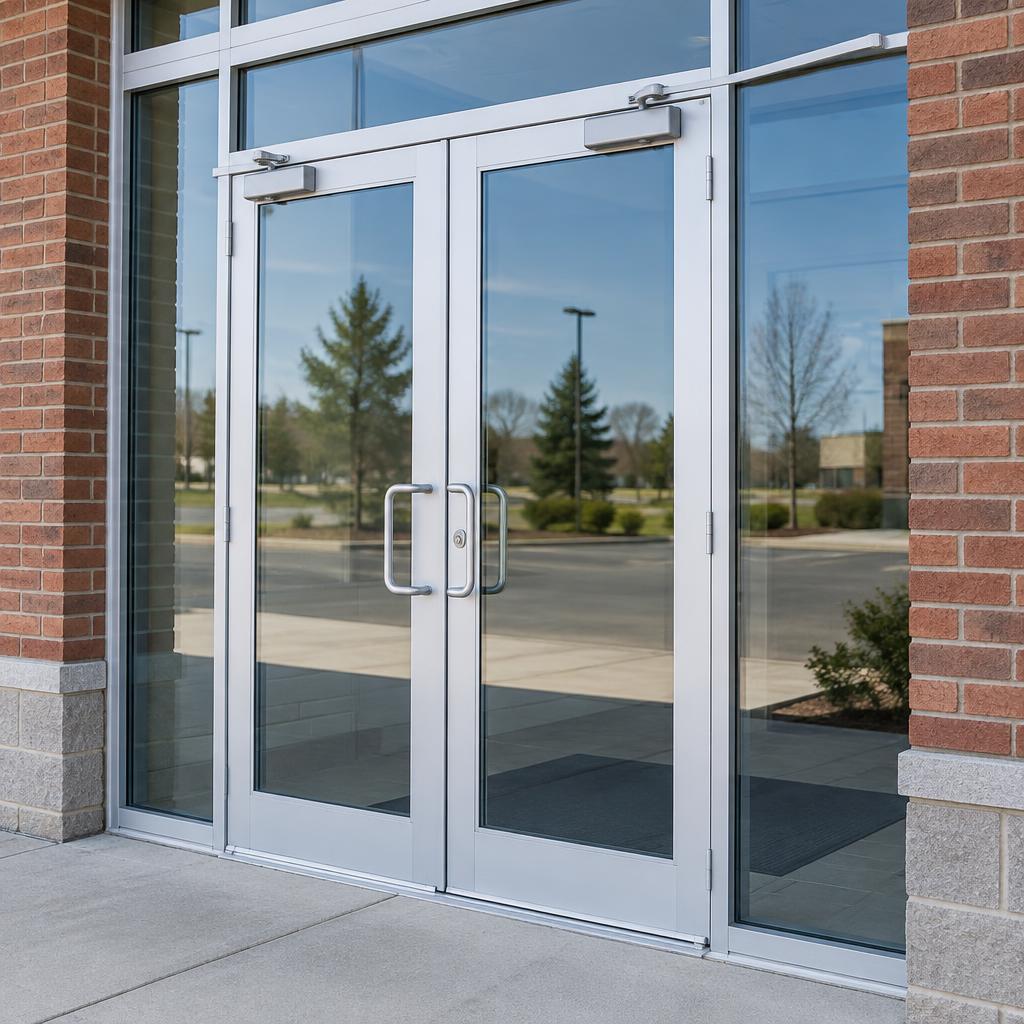
What does automatic door repair cover in Winnipeg?
Automatic door repair addresses problems with powered door operators - the motors, arms, tracks, sensors, and control boards that let a door open and close without someone pushing or pulling it. These systems are found on commercial entrances, clinics, seniors' facilities, and accessible building entries throughout Winnipeg, and when they stop working properly, it affects everyone who relies on that entrance.
Repair work can involve the mechanical side of the system - the arm or track connecting the operator to the door - the electronic side, including sensors and control boards, or the door and frame itself if misalignment is contributing to the malfunction. Because these systems combine powered mechanical equipment with electrical components, availability for repair work depends on confirmed specialist capacity, and this work is handled by trained technicians rather than as a DIY project.
Common calls for automatic door repair in Winnipeg include a door that won't open when triggered, one that opens but won't close, one that opens and closes too quickly or too slowly, or one that makes unusual noises during its cycle.
A repair call might also be prompted by a building inspection flagging that an entrance no longer meets its intended accessible function, which is a common trigger for scheduling a repair assessment rather than waiting for a complete breakdown.
Signs your automatic door operator needs repair
Automatic door problems often show up gradually before a full failure. Recognizing early warning signs can help building owners get ahead of a problem before the door stops functioning altogether, which is disruptive for staff, customers, and anyone relying on accessible entry.
Some signs point to sensor issues, others to mechanical wear in the arm or track, and others to the door and frame shifting out of the alignment the operator depends on.
- The door does not open when someone approaches or presses the activation plate
- The door opens but closes too quickly, too slowly, or not at all
- Unusual grinding, clicking, or buzzing sounds during the open-close cycle
- The door opens partway and then stops or reverses unexpectedly
- Sensors seem to trigger randomly with no one nearby
- The door appears to be forcing itself against the frame rather than aligning smoothly
How does Winnipeg's climate affect automatic door operators?
Winnipeg's wide seasonal temperature range puts real stress on automatic door systems. Extreme cold can affect the responsiveness of mechanical components in the operator, and in some cases condensation can form inside housings or on sensor lenses when a system moves between a heated interior and the cold exterior air repeatedly throughout the day.
Frost heave and gradual shifts in a building's foundation can move the door frame slightly over time, which matters more for automatic doors than manual ones because the operator is calibrated to a specific amount of travel and resistance. A frame that has shifted even a small amount can cause the operator to work harder than it should, accelerating wear or triggering safety reversals.
Winter salt, sand, and slush tracked through vestibules can also affect floor-mounted sensors and the bottom of sliding door tracks, while dry indoor winter air and humid summer air can both affect weatherstripping and seals around the door, which indirectly affects how smoothly the door operates.
Because many Winnipeg commercial entrances sit behind a vestibule, the operator may also be reacting to temperature differences between the outer and inner doors, and a system that seems to behave inconsistently through the day can sometimes be tracked back to how the building's heating cycles interact with the vestibule space.
What happens during an automatic door repair assessment?
An assessment of a malfunctioning automatic door generally starts with observing the door through several open-close cycles to identify exactly where in the sequence the problem occurs - on opening, on closing, or somewhere unpredictable in between.
The technician checks the sensors, activation devices, and control settings, inspects the arm or track mechanism for wear or obstruction, and examines the door and frame for alignment issues. Testing also typically includes checking the force and speed settings against expected safety behaviour for that type of system.
Once the cause is identified, the technician can outline what repair options are realistic - whether that is a sensor adjustment, a mechanical part replacement, frame realignment, or in some cases a recommendation that a more significant repair or system update is warranted.
Common automatic door problems and their causes
A door that won't respond to the sensor or push plate often points to an issue with the activation device itself, wiring, or the control board, rather than the door mechanism. A door that opens but closes improperly more often points to the operator's internal settings or a mechanical issue with the arm or track.
Doors that stop partway through their cycle are frequently reacting to an obstruction sensor - sometimes correctly detecting debris or ice in the doorway, and sometimes misreading a dirty sensor lens as an obstruction that isn't really there.
Noises during operation, such as grinding or clicking, usually indicate mechanical wear somewhere in the track, arm, or motor assembly, and are worth addressing before the component fails completely and leaves the door inoperable.
A door that behaves inconsistently - working fine in the morning and acting up by afternoon - can also point to a control board that is overheating slightly or a connection that loosens as the unit warms up through a day of repeated cycles, which is the kind of intermittent issue that benefits from being observed directly during an assessment rather than described secondhand.
Repair or system replacement - how to decide
Whether an automatic door system can be repaired or needs a more substantial update depends on the age of the operator, the availability of parts, and how the problem fits into the broader condition of the door and frame.
A relatively young system with a single faulty sensor or a worn mechanical part is usually a good candidate for repair. An older system that has needed several repairs for different issues, or one where parts are becoming harder to source, may be approaching the point where a more complete update is the more practical path.
An assessment is the clearest way to understand which category a given door falls into, since it accounts for the specific operator, its age, and the pattern of problems it has been showing.
What affects the cost of automatic door repair?
Automatic door repair costs vary based on several factors, and DoorMend does not publish fixed prices online because every system and building situation differs.
An on-site assessment gives the clearest picture of what a specific repair will involve.
It's also useful to think about how disruptive downtime would be for the specific entrance in question, since a secondary entrance used occasionally carries different urgency than a main accessible entrance that staff and visitors rely on throughout the day.
- Whether the issue is a sensor, control board, mechanical part, or frame alignment problem
- The age and model of the existing operator and whether parts are readily available
- Whether electrical troubleshooting or rewiring is required
- Swing door versus sliding door mechanism complexity
- Single versus double door configurations
- Whether frame or door adjustments are needed alongside the operator repair
What can building staff check before calling for repair?
There are a few simple things building staff can safely check before requesting a repair. Wiping down sensor lenses and activation plates to remove dust, grime, or condensation can sometimes resolve erratic triggering. Clearing ice, snow, or debris from the floor track or threshold area can also resolve a door that seems to stop or reverse unexpectedly.
It is also reasonable to note the specific pattern of the problem - does it happen every time, only in cold weather, only with certain people approaching, or only at certain times of day - since this information is genuinely useful for a technician during the assessment.
What should not be attempted is opening the operator housing, adjusting internal mechanical settings, or working on any wiring connected to the system, since these components are powered and carry both electrical and mechanical safety risks. This is specialist work, and the appropriate step once basic checks are done is to stop and request a proper repair assessment.
Maintenance to reduce automatic door breakdowns
Routine, simple maintenance can meaningfully reduce the frequency of automatic door breakdowns. Keeping sensor lenses and activation plates clean, keeping the track and threshold clear of debris and winter salt residue, and watching for any change in operating sound or speed all help catch small issues before they become full failures.
Seasonal checks, particularly heading into winter and again after the spring thaw, can catch frame alignment shifts from frost heave before they put extra strain on the operator.
For high-traffic commercial entrances, more frequent informal checks by staff - simply noticing if the door seems slower, louder, or less consistent than usual - can prompt an earlier service call and avoid a full breakdown during business hours.
Building staff can also keep a simple written log of when the door misbehaves, noting the day, time, and weather conditions, since patterns tied to temperature, time of day, or specific weather events can be genuinely useful information during a repair assessment.
Businesses, clinics, and residential buildings - different considerations
Automatic doors in high-traffic commercial settings, like retail entrances, see more wear simply due to volume of use, and breakdowns there have a more immediate impact on customers and daily operations.
Clinics and seniors' facilities often have accessibility requirements that make a reliably functioning automatic door especially important, since residents or patients may depend on it specifically because manual doors are difficult or impossible for them to use.
Condo and apartment buildings with automatic lobby entrances may need to coordinate repair timing with building management and resident notice, particularly if the door needs to be taken out of service temporarily during the repair.
Many building managers also find it useful to flag automatic door servicing alongside other seasonal building maintenance tasks, so that sensor cleaning and a basic functional check become part of a regular routine rather than something only considered once a problem has already appeared.
More questions about automatic door repair
Why does my automatic door only act up in cold weather? Cold temperatures can affect operator responsiveness and can make any existing frame alignment issue more noticeable, since tolerances tighten up in the cold just as they do with other door types.
Can a malfunctioning sensor be replaced without replacing the whole operator? In many cases yes, provided the rest of the system is in good working order; an assessment will confirm whether that is realistic for the specific system.
Is it safe to keep using an automatic door that stops and reverses unpredictably? It is best to have it looked at promptly, since inconsistent obstruction-sensing behaviour can be a sign of a sensor or control issue that is worth addressing rather than working around.
Does DoorMend repair all brands and models of automatic door operators? Availability depends on confirmed specialist capacity for the particular system involved, which is discussed as part of the initial conversation about the repair.
How do I request a quote for automatic door repair in Winnipeg? Describe exactly what the door is doing - or not doing - including when the problem happens and any sounds or behaviours you've noticed, and send photos or a short video if you can. An assessment from there determines what repair is realistic and whether specialist capacity is available. An enquiry starts that process; it is not a confirmed booking.
Automatic door repair cost in Winnipeg versus a full system update
Building managers comparing automatic door repair against a larger system update often want a general sense of how the two paths compare before committing to an assessment. A targeted repair, such as a sensor swap or an arm adjustment, generally addresses a specific fault without touching the rest of the operator, which keeps the scope of work contained to the part that failed.
A fuller system update becomes more relevant when multiple components are aging at once, or when the existing operator is no longer well supported by available replacement parts. In that situation, patching one failure after another can end up costing more in total downtime and repeated service calls than addressing the system more comprehensively in a single project.
Because every building, operator model, and usage pattern is different, DoorMend does not publish fixed repair or replacement pricing online. An on-site assessment remains the most reliable way to understand which path makes sense for a specific entrance, and building managers are welcome to ask about both options during that visit so they can weigh them against their own budget cycle.
Sliding versus swing automatic doors - different repair patterns
Sliding automatic doors and swing automatic doors rely on different mechanical arrangements, and the repair issues that show up on each tend to differ as a result. Sliding doors depend on a track and roller system, so track debris, roller wear, and belt tension are common culprits when a sliding unit starts behaving inconsistently, particularly after a winter of sand and salt being tracked through the vestibule.
Swing automatic doors rely on an arm mechanism connected to the top of the door, and problems here more often relate to arm alignment, hinge wear, or the door itself dragging against the threshold or frame. A swing door that seems to struggle only on the push side, or only on the pull side, is often pointing toward an arm or hinge issue rather than a sensor problem.
Why do automatic doors sometimes fail right after a power outage or electrical interruption?
Automatic door operators rely on a control board that stores certain settings and expects a consistent power supply to operate predictably. After a power outage, brief electrical interruption, or even a building-wide circuit reset, some automatic doors come back in an unexpected state - stuck in a locked position, cycling slowly, or not responding to the activation plate at all.
This pattern is worth mentioning specifically when requesting a repair assessment, since a door that worked normally before an electrical interruption and then stopped working afterward points the technician toward the control board and its settings rather than a mechanical fault in the arm or track. Any further electrical troubleshooting beyond a basic reset is handled by a trained technician rather than building staff, since it involves the powered components of the system.